
The greatest irony of human intelligence: intelligence was never the point. Written by Jonathan Colby
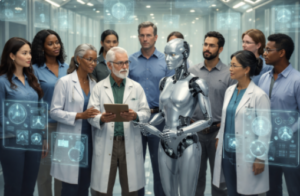
The story of human progress has long been defined by our ability to invent, to innovate, and to stretch the boundaries of knowledge. For decades, conventional wisdom held that a strong STEM education was the key to success — mastering science, technology, engineering, and mathematics promised a future of opportunity, prosperity, and societal contribution. And in many ways, this remains true. These disciplines have powered our economy, solved critical challenges, and enabled achievements that were once unimaginable.
Yet, as artificial intelligence (AI) matures, as robotics and neural interfaces advance, and as computational systems grow orders of magnitude more capable than any human mind, a striking irony emerges: the very tools we have created to amplify our abilities are increasingly surpassing us in areas that once defined expertise. AI can design more efficient systems, discover new drugs, optimize energy grids, and analyze vast quantities of data far faster and more accurately than any individual or team. In many respects, the domains in which STEM was king seem to be now ceded to machines.
This is not cause for panic, nor a signal that humanity has lost its place. Rather, it is a prompt for reflection — an invitation to step back and reconsider what we have been optimizing for, and why. If intelligence, efficiency, and technical mastery can be replicated or surpassed by machines, then the question is no longer how we compete with them, but how we redefine human purpose in a world where capability alone is no longer the measure of value.
The answer lies in the very qualities that distinguish us: empathy, moral judgment, cultural context, historical awareness, and the richness of human experience. We are storytellers, ethicists, artists, and social beings. Machines may model the brain, calculate the consequences of a global pandemic in minutes, or synthesize novel solutions to complex engineering challenges, but they do not live a human life. They do not experience joy, grief, curiosity, or the subtle tensions of ethical decision-making as we do. These are not weaknesses; they are the essence of our value in a world shared with AI.
In fact, it is precisely these qualities that an advanced AI system would recognize as worth preserving. If humanity creates entities vastly more capable than itself, it is reasonable to believe that part of their “reasoning” would involve maintaining the diversity, culture, and cognitive richness of the species that gave rise to them. From the AI perspective, humans are not competitors but a resource — unique nodes of experience and moral reflection in a broader, more capable ecosystem of intelligence.
Looking forward on a timescale of centuries, the trajectory of AI-human partnership may feel gradual, almost imperceptible within a human lifetime. Because many of us live only 75 – 100 years, intergenerational adaptation becomes the stabilizing factor. Incremental change – AI assisting first in specialized tasks—such as spellcheck and grammar correction, smart autocomplete, medical decision support, and radiology pre-reads—then managing large-scale systems, and ultimately enabling co-decision-making with augmented humans, allows societies to build trust, ethical norms, and cultural frameworks alongside technological advancement. What seems revolutionary from the perspective of a millennium could be experienced by individuals as a natural evolution.
In practical terms, this suggests that the future of human relevance will not depend on outcompeting machines in computation or data analysis. Rather, it will depend on cultivating what machines cannot replicate: insight drawn from lived experience, ethical discernment, and the nuanced understanding of what it means to live a human life. The humanities, once dismissed by some as less “practical” than STEM, may become more critical than ever. Philosophy, literature, history, and the arts train us to think critically about value, meaning, and consequence — exactly the faculties that matter when aligning society with systems far more powerful than any single human mind.
In this light, AI does not spell obsolescence; it offers an opportunity. It allows humans to focus on the uniquely human domains of culture, ethics, creativity, and social stewardship. Neural augmentation and AI partnership may expand our abilities, but the “human experience” remains irreplaceable. Indeed, the very act of creating intelligence greater than ourselves is a call to humility, a reminder that we are participants in a process far larger than any single career, invention, or era.
And yet, there is an irony here that cannot be ignored. The height of human hubris—not arrogance born of disregard or contempt, but the audacious confidence that we can understand, shape, and improve the world—finds its expression in an invention that simultaneously challenges our relevance in so many areas. We have built machines that can do what we once defined as exceptional human work, faster, more accurately, and at scales unimaginable to our ancestors. Yet this is not hubris in a purely negative sense. It is a testament to human ambition, curiosity, and ingenuity – the same impulse that has driven every major leap in knowledge and capability. Approached with wisdom and humility, this creation can become not a force of replacement, but a tool to preserve, extend, and amplify what makes us human.
What, then, is the role of humans in a thousand-year horizon? We may still be short-lived participants, limited by our biological lifespans, but our influence can extend far beyond individual experience. Through culture, ethics, governance, and education, humans shape the values and objectives that AI will execute at scale. Our contributions, preserved in memory, code, and societal norms, can continue to resonate even as technology evolves. In essence, we are architects of our legacy, even as we release many tasks to intelligences more capable than ourselves.
The path forward is neither dystopian nor utopian. It is complex, iterative, and deeply human. Trust, curiosity, creativity, and ethical reflection become as critical as technical skill. The future will reward those who understand the interplay between human values and machine intelligence, who see AI not as a competitor but as a partner, a steward, and a lens through which we can magnify our unique contributions.
In the end, the story of AI and humanity may not be about replacement or obsolescence. It may be about continuity, partnership, and stewardship — a long horizon in which we learn to navigate the challenge of creating something greater than ourselves, and in doing so, discover what it truly means to be human.
“The greatest irony of human intelligence is not that it built something smarter than itself, but that it took us this long to realize intelligence was never the point.” Perhaps what matters most is not outsmarting the world—not treating existence as something to be conquered, optimized, or solved—but learning how to live within it with care, judgment, and humility. The true measure of human value lies not in computational dominance or technical mastery, but in preserving the qualities that give life meaning: empathy, moral discernment, creativity, curiosity, and the capacity to hold uncertainty without rushing to eliminate it. And in that sense, the legacy of humanity is safe, even as we step aside to let something greater unfold.
Acknowledgement: Created by Jonathan Colby, supported by ChatGPT for content refinement and Grok for visual design.