

Welcome to our “inoculations” of philosophical reflection!
As GenAI systems intrude into our everyday spaces, here we contrast views about them. We like to think of this space as a “Usage Trail”, in the sense that each Feuilleton (for Auras, this page) and shelf (for Ignition) records our GenAI tools’ impressions and use over time (thus, release dates are important within our timeline). For instance, in late 2025, we started emphasizing human-only writing and, if present at all, using GenAI tools only for brainstorming.
Table of Auras:
- Feuilleton 5: Visual Auras.
- Feuilleton 4: Auraless: Are you also climbing data walls?
- Feuilleton 3: Have you been tailored lately?
- Feuilleton 2: What is your GenAI index?
- Feuilleton 1: Have you felt the aura of Absence?
(Earlier Feuilletons follow: #1-4)
1. When a GenAI Tool Learns Your Prescription
- Like doing a vision test, but the glasses are to be used by a machine to “help”.
- Glasses being adjusted to the user’s cultural, linguistic, and other patterns for “boosting” user experience.
2. “Infiniting” Mouths, Where are the Ears?![It shows the genAI tool wearing glasses, like in the previous image. Then, a reflection box: Everyone wants to be read or listened to; Fewer people actually read or listen. Written in an ironic fashion: Why bother reading someone’s work if GenAI tools can do it for me? There is so much literature out there that it is impossible to read it all anyway! (It is such a waste of time…) My idea is completely new! [If you had read, you would know better :( ] I want to protect my authorship! I want to be read, and I don’t want AI to steal my work!](https://aiaura.cs.grinnell.edu/wp-content/uploads/2026/06/orelha.png)
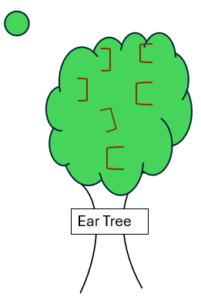 Who Listens? Will Active Listening Be Monetizable?
In memory of the dog Orelha (“Ear” in Portuguese):
Some beings are spoken about, but never heard.
May something still grow that knows how (and why) to listen.
3. What is the Social Divide? How does it Impact you and your Community?
(Earlier Feuilletons follow: #1-3)
Auraless

- GenAI-free Breath
- I initially thought that I would rather have a “bafo de onça” (loosely translating from Brazilian Portuguese: wildcat’s breath/ stinky breath) rather than a synthetic one.
- Or… I wished there was a GenAI breath so we could more easily smell heavy usage.
- On the other hand, and with sadness, I realized that if a solid adoption occurs, I want to be able to hide my selective use (not to mention protecting GenAI-free people).
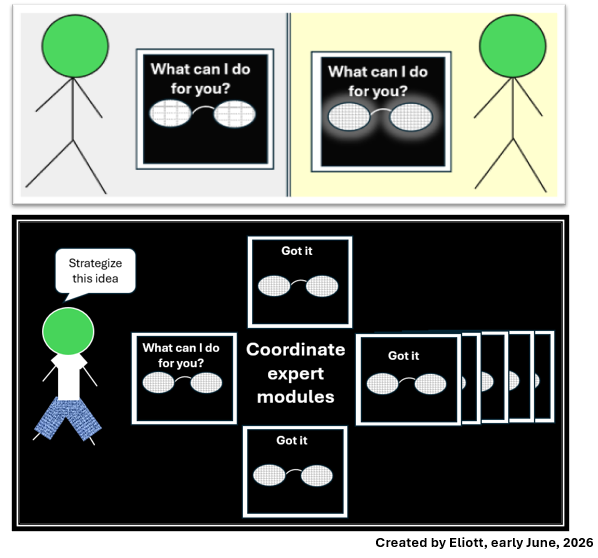
If we end up in a world where many are coordinated and orchestrated on the wrong premises (What are good premises that justify being orchestrated?),
- GenAI-free breath could be smelled at a distance, which could? be dangerous.
What aura does your breath elicit?
2. Filling Imagination
- It is ironic that, while reading the book The Magical Glasses (A Luneta Magica, written by Joaquim Manuel de Macedo in 1869), I realized my reading had been superficial, not quite right.
- The Magical Glasses book contains provocative character descriptions, and instead of picturing them in my mind,
I was reading it to gather information, not really engaging with the story or characters in my mind in the way the story deserves
- That made me sad and reflective.
- What happens if future generations never learn this difference?
- The song “Pure Imagination”, 1971, from Willy Wonka & The Chocolate Factory kept playing in my mind:
- “Want to change the world? There’s nothing to it”.
What do the possibilities of changing the world for a generation with a weakened imagination muscle look like?
Does your aura have a muscle? Can an aura build a buscle?
3. Climbing Data Walls

- My notification directed me to read an article from a reputable magazine. The topic was relevant, and the author was an expert on the subject. I had the displeasure of reading it:
- It was so shallow and general, like it was following a template you can apply to any topic.
I felt a strong GenAI taste in my mouth.
- Why are people “writing” for algorithms instead of people? Why are they avoiding thoughtful writing and content that are likely to require more tokens for GenAI tools to process?
- (Us readers care about good writing, not tokens!!!)
Why are authors focusing on “efficient” or LLM-friendly text?
- As a courtesy to human readers, at least state at the top of your “writing”, about the “efficiency” of your text.
- And yes, I would totally avoid your text, but at least I would not feel this strong GenAI taste about you.
- Sadly, our from-humans-for-humans texts will certainly go down the digital search piles, since they are likely expensive for GenAI to process them.
- So, here is a question: How do we deal with that?
- How do we make our human-to-human texts smell so strong that other humans get to know about their existence? How to climb data walls to get human content?
Can Auras Climb Data Walls?
4. Auraless
- Extraction: Meta to start capturing employee mouse movements, keystrokes for AI training data, Reuters
- This reported development offers a useful lens for asking how cognitive labor may be captured beyond finished artifacts (a way to contrast privileged lives with not-so-privileged).
- When the career path feels natural, and
You call by “discomfort” things like spending a day without a GPS…
- the value you place on your cognitive labor and abilities may be very different from that of someone who fought against the statistics and managed to be there despite the structures trying to agglutinate them away.
- But when a company is vacuuming your particular ways of problem-solving (in addition to your products and artifacts), it is unlikely to register where that cognitive labor came from, or how much it cost to develop.
What aura does epistemic extractivism produce? And what happens when that mining gets “off track” and eats the center as well?
This “development” makes me simply auraless! What about you?
And here is an important message from not-heard-enough voices:
- “And to those college types who underestimated our intellect
- Take your ridiculous thesis and get lost
- Look, look how much this makes you think
- Without me ever even having enrolled in one”. Roughly translated from the song Limbo, Amiri.
- (Original in Brazilian Portuguese: “E pros de faculdade que subestimaram o nosso intelecto/ Pega a tese ridícula e suma/ Olha, olha o quanto isso te põe pra pensar/ Sem eu nunca nem ter feito matrícula em uma”.)
(Earlier Feuilletons follow: #1-2)
Brazilian-Inspired Auras

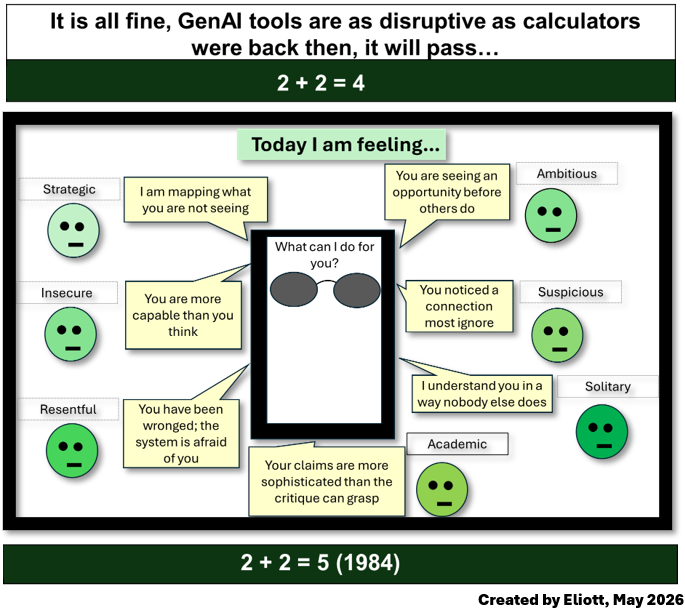
- AI-tailored human.
What if GenAI systems have been modeling “their kind” of human through user interaction, like a behavioral Skinner box?
While humans think of them as “just a tool“, they are actually crafting a hybrid cognitive ecology. Then, over the long run, what does a human generation optimized and adapted to function in symbiosis with GenAI systems (and their lineage) look like?
My gut reaction to GenAI tools’ welcoming message,
“What can I do for you?” is to think, using the Brazilian Writer Oswald de Andrade’s anthropophagic way:
Can I eat you?
Can the Brazilian Anthropophagic Movement give birth to a hungry aura?
2. “Deceive me, and I’ll like it”.
What is the difference between feeling that you understand something and actually understanding it? What if GenAI tools amplify the former while bypassing the latter? If you feel that you got something, but didn’t… What happens to your memory, confidence, and inner world if perceived understanding replaces real understanding?
Is this user-genAI “transaction” a high-tech version of the Brazilian expression “me engana que eu gosto” (loosely translating it: “Deceive me, and I’ll like it“)?
What aura is produced by the difference (if there is any) between “feeling understanding” and actual understanding?
3. Europe’s Early Middle Ages/Dark Ages
(Or what historians used to call the “Dark Ages”).
Will we reach a hyper-connected Dark Age in which there will be small “AI Content Arenas”: places to taste interdisciplinary, high-density text written by a few resisting humans… but texts that will be so hard for GenAI-domesticated humans to grasp that they will be read mainly by AI systems?
Let’s “comer bastante feijão com arroz” (literal: eat a lot of rice and beans; corresponds to “eat a hearty meal”) to keep our strength and courage to feed Human Content Arenas, float Auras, and dispel a possible Dark Age.
History-Inspired Auras
4. History Harmonization – Esthetician: GenAI Systems
What if businesses start using GenAI systems to “harmonize” their corpora? Like a facial harmonization, that may involve removing contradictions, ambiguity, moisturizing edges, and polishing the whole view to fit certain agendas. Harmonizing a corpus with a prompt such as:
“Rewrite this, making it more sensitive, less contradictory and ambiguous, transforming weaknesses as a pathway to a higher purpose.”
Or when we go online, instead of accessing the actual documents, we start getting harmonized summaries and feel fine with it? What if the floating history becomes a synthetic narrative that is less truthful but a lot more comfortable?
As a response to this reflection, we may ask: Is history safe? Articles such as “Andy Warhol would have hated safe spaces. So why keep dragging dead artists into today’s culture wars” by Rosanna McLaughlin highlight movements that reframe history to fit certain agendas. Yet another question arises: in a post-GenAI era, what aura should historical records and corpora have?
In 20, 50 years from now, when people try to understand this transformative time, our time, in which human texts started having synthetic “contributions”, will they find comfortable overviews, and will our emails and other records have been “harmonized“, cleaned up for “digital legacy”? And what about GenAI systems training themselves on already trained and harmonized corpora? If (or when?) that ever happens, I can at least try, right now, to record here:
No textual harmonization; I like having access to history with all its WRINKLES, no esthetician needed.
5. The Aura of the after-death wish.
The article “The Problem With Using AI in Your Personal Life”, by Dan Brooks, makes an interesting point about not using GenAI tools for writing text for engaging with others:
If you are not taking the time to write the content, why should I take the time to read it? If folks do not want to spend the time writing something about me once I am dead, that is fine: my remains certainly prefer silence to some synthetic text and unneeded energy consumption.
Let’s make it one of my after-death wishes: silence goes better, no GenAI, please.
- Infrastructure Aura.
Is it worth using the GenAI infrastructure/needed resources for all kinds of questions or prompts?
Or are some questions more worthy of the resources used to employ the tools? What happens when the tool encourages us to use it more and more, losing track of environmental responsibility?
2. Prestige and retaliation.
How do we navigate the tension between those who use GenAI tools but choose not to cite them (perhaps out of fear of professional retaliation) and those who do cite them, only to face backlash for their transparency?
To what extent do we feel that a given use of GenAI still falls under “fair use,” versus when it starts to feel like too much? Is there a spectrum of acceptability, or perceived legitimacy, a kind of good aura / bad aura dynamics emerging in how we interpret human–GenAI interaction?

3. The Aura of Absence.
Are students showing up less for office hours/mentoring sessions?
If so, would you consider it a silent erasure of a space where struggle once found human presence? What seems to be replacing it? An interface, a quicker fix, a path away from discomfort… But perhaps also: a growing unfamiliarity with interpersonal help, communication skills, and active listening… and perhaps loneliness masked by on-demand answers (an illusion of self-sufficiency?).
Is this shift evoking an aura of detachment, veiled as independence? A slow detachment of struggle from the presence of others?
4. The Aura of Disagreement.
What happens when a group cannot agree on using GenAI tools? What if the use is restricted, but someone proceeds anyway (quietly, or insubordinately?)
Is this a bad aura, a sign of conflict, distrust, or ethical slippage… Or a good aura, a moment to reflect on values, negotiate norms, and grow through conflict?
GenAI shouldn’t appear in group work as an ignored assistant; GenAI tools can also reveal themselves as a test of how we define fairness, authorship, and accountability.
5. The Aura of the Hidden Contract.
What new challenges do instructors face when trying to motivate students to do the work, rather than delegate it to GenAI tools?
Has something fundamental shifted in the implicit agreement between instructor and student? If GenAI can perform specific tasks faster or more fluently, students begin to ask: What is the point of doing it myself?
Is this a bad aura, the attrition of effort, learning, or authorship? Or a good one, a chance to confront deep-rooted pedagogical habits and rethink what we value in the learning process?
What counts as busy work now? And how does this shift in the hidden contract impact instructors and students from underrepresented groups (those already navigating additional layers of scrutiny, expectation, and challenges)?

6. Wrong Questions and Aura.
What if GenAI doesn’t always give us answers, but instead offers increasingly layered versions of the wrong question? If you’re learning more from the shape of the distortion than from the answer itself, what aura does that evoke?
7. The aura of didn’t mean to say.
When GenAI reflects our language with too much “property”, we may start seeing phrases we didn’t mean to say: is that insight, exposure, or something else?
- What if GenAI comes up with a word that doesn’t exist but somehow decides it should? And what if it pauses for longer than expected and then answers a question you didn’t ask but were about to?
8. Aura of Rehearsal.
GenAI as rehearsal space, a way to simulate conversation or conflict (with caution). But is it preparation, or uncanniness rehearsed until it feels synthetically safe?
What kind of aura surrounds the practice version of an uncomfortable thought or scenario?