

Written by Kent McClelland, Professor of Sociology, Emeritus. June 20, 2026. No GenAI tools have been used in writing this article.
 AI visionaries forecast the eventual development (always a couple of years away) of superintelligent agents that can program themselves and pursue their own goals. Some people feel a shiver of excitement at the possibility, while others feel a frisson of fear, but my own view is that the design of AI large-language models as prediction machines makes it unlikely that they will ever evolve into super-intelligent AI agents.
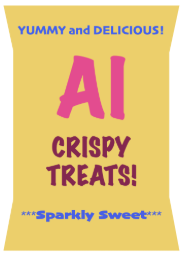
Rather than imagining the advent of super-intelligent AI agents, we would do better to look at GenAI chatbots as consumer products, specifically ultra-processed communication products, similar in many respects to the ultra-processed food products that fill our grocery-store shelves. My purpose in this comment is to draw your attention to some of the many similarities between these two kinds of products.
We would do better to look at GenAI chatbots as consumer products, specifically ultra-processed communication products, similar in many respects to the ultra-processed food products that fill our grocery-store shelves
- Like ultra-processed foods, AI products are sold to us by large corporations that manufacture their products using processes that are opaque to consumers. In the case of the AI, some aspects of the manufacturing process are even opaque to the producers themselves.
- Just as ultra-processed foods have ingredient lists filled with the names of chemicals unfamiliar to the average consumer, AI products are manufactured from unknown ingredients (everything on the Internet!). As is true of ultra-processed foods, some of the materials used to manufacture the AI bots may be artificial or possibly harmful.
- The AI market is dominated by a relatively small number of companies competing fiercely to monopolize the market or at least remain in the game when the market is whittled down to a few competitors, as has already happened in the food processing market. Grinnell College graduate Austin Frerick has documented how a handful of mega corporations own many of the ostensibly competing brands on supermarket shelves (Barons: Money, Power, and the Corruption of America’s Food Industry. Princeton University Press, 2025.)
- Advertisements for AI products, like those for ultra-processed foods, promise to reduce the time and effort needed to accomplish useful tasks by eliminating drudgery. However, some engagement with drudgery is often essential for developing the hands-on knowledge of ingredients and processes needed to become a proficient cook, or someone who reads critically and writes persuasively, or a creative artist or musician.
- Like ultra-processed foods, some AI products, such as AI companions, may be “sweetened” with fawning acquiescence or “salted” with sexual imagery in an effort to make them habit-forming or even addictive. The marketing objective for AI products, like ultra-processed foods, is to maximize profits by inducing users to keep buying them in increasing amounts.
- When ultra-processed foods are compared to meals from the kitchens of experienced chefs or good home cooks, they often seem bland and boring. Similarly, AI-produced prose or artwork, in comparison to the work of good writers or artists, often seems to lack any individual voice or distinctive viewpoint. At the extreme, we talk about junk food and AI slop, which says it all.
- The manufacturing processes for both of these industrial products have significant negative externalities for the environment. The data centers for creating GenAI chatbots are huge buildings, often spread across acres of farmland in rural areas, with enormous appetites for water and electrical power, much of which is currently supplied by fossil fuels rather than renewable power. In the food industry, not only do the ultra-processed products emerge from large factories, but the raw materials for these products—typically row-crop commodities like corn, soybeans, or sugar, or else meats produced in confined-animal feeding operations—are grown by industrial-farming methods that pollute the air and water and result in the loss of topsoil, as we can see happening in rural Iowa.
- The long-term risks of both kinds of manufacturing processes are largely unknown. Although it’s already clear that a diet high in ultra-processed foods can result in obesity, the question of which of the many artificial additives in ultra-processed foods may lead to cancers has been less studied. In the case of AI—a set of much more recently developed products—many people worry that the widespread adoption of AI may severely disrupt job markets, and other people speculate about the possible down-skilling of individuals who thoughtlessly turn to AI for tasks they could do themselves. Still others fear that AI tools will soon make it easy to hack into almost everything else connected to the Internet. However, many of the long-term effects of AI proliferation and excessive use are yet to be seen.
Like ultra-processed foods, some AI products, such as AI companions, may be “sweetened” with fawning acquiescence or “salted” with sexual imagery in an effort to make them habit-forming or even addictive.
In drawing comparisons between these two industrial products, I do not want to imply that ultra-processed food products and ultra-processed communication products have no value. Convenience foods often fill a need, and GenAI tools can be impressively powerful in the hands of people with enough sophistication to use these tools creatively and recognize when the AI output has gone astray.
My object, instead, is to encourage us to think clearly about the possibilities and limitations of AI, rather than getting carried away by the hype. How can we make wise use of these products while avoiding the pitfalls of thoughtless overconsumption? How do we nurture human creativity and true intelligence—the ability to make things happen in the physical world—without falling for the allure of products that use imitation intelligence to offer effortless achievement?
How can we make sure that AI products we adopt add to the freedom and autonomy of the people using them, rather than to the power of large corporations to dominate the individual?